Showing posts with label Tutorials. Show all posts

Monday, April 9, 2012

Upcycled Skorts

Hello!  I hope you enjoyed Easter.  We had a wonderful Easter morning, church service, and lunch.  Then the rain came.  But that's ok - we can use the rain.  I will admit, after all the tornadoes that came through last week, I am a little weary!  The tornado that hit Arlington close to I-20 is only miles from my home. Scary, huh?  There was a lot of damage, but miraculously there were only minor injuries and NO fatalities!  Thank you, God!
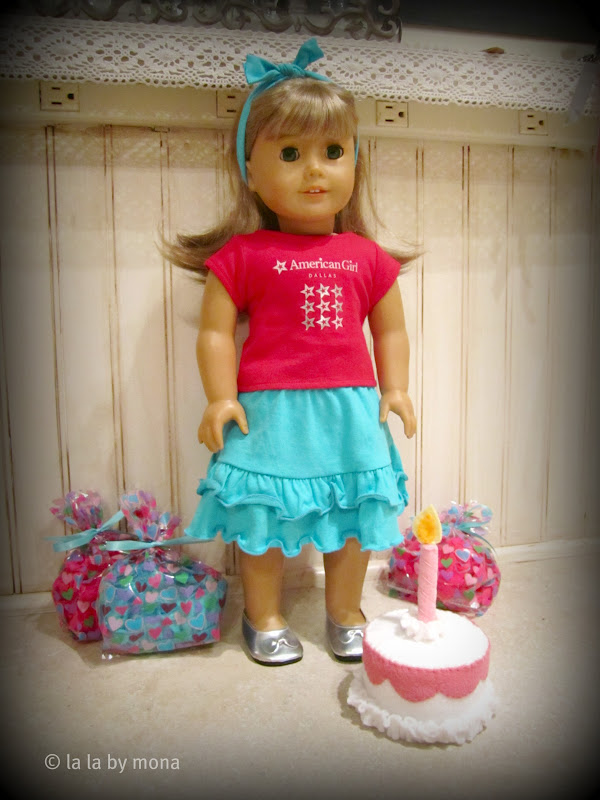

Today I wanted to share another upcycling project with you.  I took two pair of skorts that  my daughter never wore from last summer and turned them into four skirts for 18" dolls!  Keep in mind that these were done quickly and the night before my daughter's birthday party at the American Girl doll store.  I wanted to make skirts for her friend's dolls as party favors.  They turned out just as cute and the girls loved them.  So, here we go.

Before and after.... you can see the size 5T pink skort and the upcycled blue doll skirt.


1.  Take the skort apart - cut off the waistband (the shorts will come out, too); then cut the skort straight down the middle and straight down the back.  This leaves one finished side seam already sewn.


2.  Cut off any excess from the top of the skort to the desired length needed for the doll skirt.  Leave about 1" extra for the waistband.  No exact measurements here, just eyeball what you like!


3.  This is the skirt after cutting and trimming.  We are now ready to add the elastic for the waistband.


4.  Using a 10" length of 1/4" elastic, find the middle of the elastic and pin that to the middle of the top of the skirt (on the inside).


5.  Now pin the elastic to each side of the skirt.  In the photo below, the material has been stretched out for a visual.


6.  You will now sew the elastic to the material.  Tack down the material to hold the elastic in place.  Hold the material at the middle pin with one hand and stretch out the elastic to the width of the material (from the top pin to the middle pin).  Only stretch the elastic, taking care not to stretch the fabric past its regular width.  Stitch down the elastic using a zig-zag stitch.  Continue with the other half of the skirt using the same steps above.


7.  When finished, the elastic will go back to its original length, drawing the material up.

 8.  This is what it will look like from the right side.


9.  Fold the elastic over toward the wrong side and pin to hold in place.  Using a straight stitch, sew the elastic in place, stretching the material out slightly as in the steps above.


10.  Shown after sewing the elastic down.  It isn't as finished as making a casing, but it is quick and the doll doesn't care!


11. The right side after sewing the elastic down.  Okie dokie, eh?


12.  The last step is to sew the sides together.  (Sorry, no photo.)  Pin the wrong side of the skirt sides together.  Sew together using a straight stitch.  You can use a zig-zag stitch down the side or serge to finish. 

All done!


I loved these particular skorts because of the ruffles.  Less work for me and so cute for the doll!


I hope you enjoyed the project and have lots of fun making your own.  I would love to see photos so be sure to email them to me!
Pin It

Saturday, January 14, 2012

Prettied Up - Old Spool Style

What happens when you reorganize?  Well, sometimes you end up with things that are still useful, but maybe not in their present state.  Maybe they aren't as pretty or don't fit your current style.  This happened to me when I decided to organize my stash of ribbon.  I used old, wooden spools for many of my ribbons and ended up with the empty cardboard/paper spools.  Throw them away?  Nah, just pretty them up!


To pretty up your spool stash, grab these lovelies and get started...

  • cardstock or colored paper
  • pencil
  • scissors or Martha Stewart paper cutter (that I also used here)
  • Mod Podge or similar glue
  • foam brush (or flat bristle brush)
  • exacto knife
  • ink pad (optional)
  • sponge dauber (optional)


Measure the width of your spool.  Cut out two circles from the paper for each spool.  You can also trace the spool onto the paper with a pencil and cut the circles out with scissors.


Using a sponge or flat bristle brush, apply the glue liberally and evenly to the back of one circle.  Place this on the side of the spool and gently use your fingers and palm to smooth the circle onto the spool.  Take care not to move the circle as the glue sets up quickly and makes it hard to reposition.  Repeat with the remaining circle and the other side of the spool.


Let the circles dry.  If you prefer, you can use an exacto knife to cut out the hole in the side of the spool.  This is great for hanging the spools of ribbon on a dowel rod.  I found the middle of the spool, poked a hole in it with the knife, and while holding it up to the light, cut out the circle.  It was easy to see and cut this way.  I also used a dowel rod to push in the cut area of the spool center.  I then used my finger to gently soften the edges a little more.


If you like the vintage or aged look, you can use a sponge dauber to apply ink to the edges of the circles.  It doesn't take much to add a little color.  I used a sepia brown ink on mine.  If you don't have a sponge dauber, you can wrap a piece of paper towel around your finger, pat the stamp a little to receive the ink, and then lightly apply the ink to the edges.


And there you go!  I like these much better now.  Stickers with SKU numbers and ribbon widths and lengths just weren't my style!


I think I'm going to purchase a long dowel rod that I can insert between the brackets of the shelf that sits above my chalkboard.  It will free up some counter space and, you guessed it... pretty it up!


Pin It

Monday, November 21, 2011

Chalkboard Tablecloth

Have you tried chalkboard fabric?  It is wonderful and has so many uses like the one in my last post.  BFF Harriet gave me a roll of this wonder fabric about a year ago.  I kept waiting for that "perfect project" and finally found it.  I saw something similar on Kellie McCants Oilcloth Addict blog.  I would love to get my hands on her book, Sewing with Oilcloth (hint, hint Santa). 

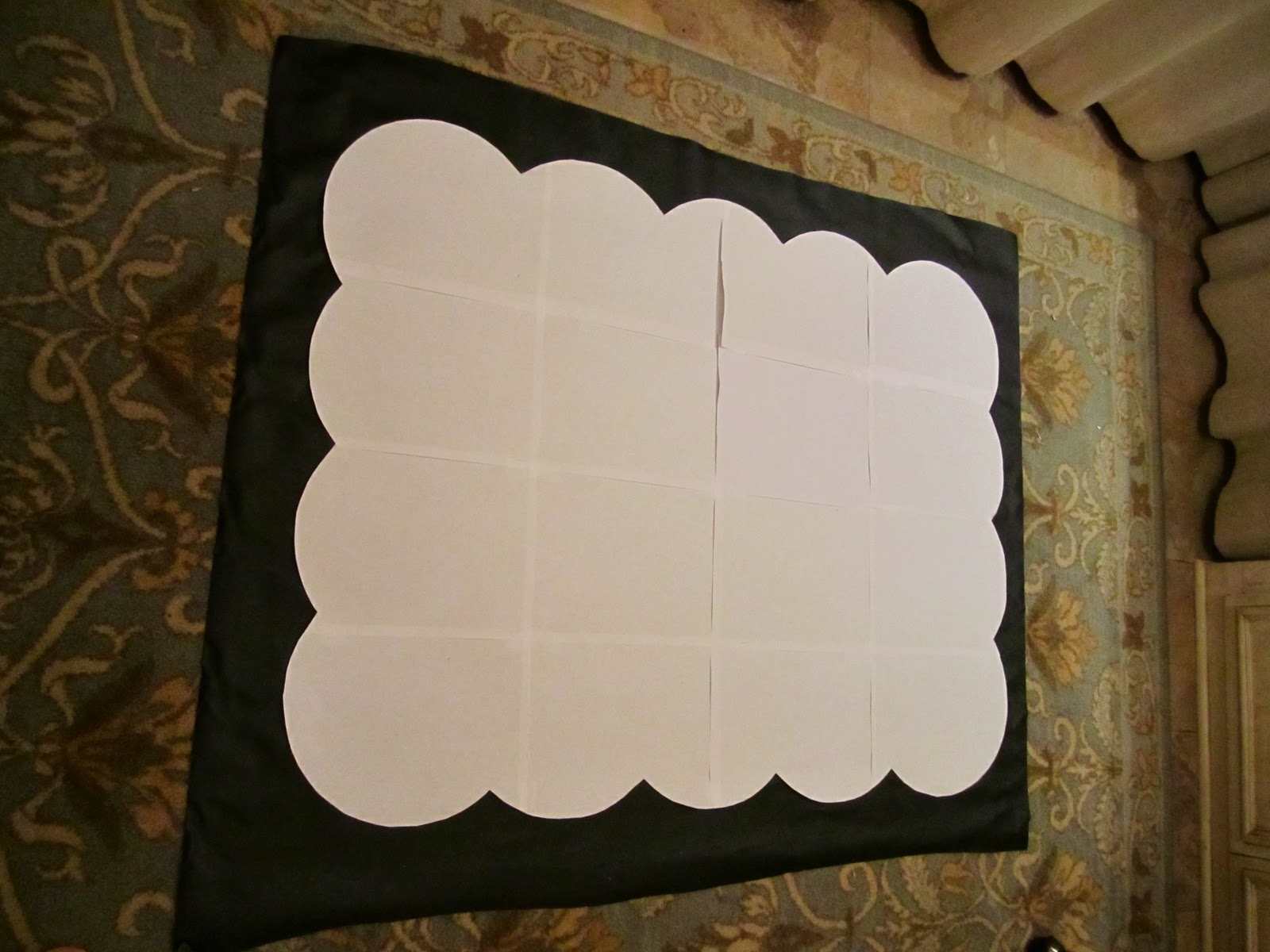
Anyhoo, until I get the book (uh hem, Santa), I made my own pattern.  I taped lots of sheets of paper together.  Don't worry - I used paper from the "scrap" box.  They just happen to be flipped over to the plain side.


I used a standard dinner plate to draw my "scallops".  I just kind of eye-balled them!


I then cut out my scallops and took a look-see to make sure it looked okay.  I didn't take pictures of the next steps, but did this to complete the project:  turn the chalk cloth over and lay the pattern on top; using a Sharpie marker, trace the pattern; cut out with pinking shears.


Next, you will need to "prime" the chalk cloth.  With a piece of chalk on its side, go back and forth all over the chalk cloth until it is covered with chalk.  Use an eraser to erase most of the chalk.  Then, use a damp sponge or cloth to take the remaining chalk off the chalk cloth.   It may take several times of wiping to get it back to a clean black surface.  Kitty Moo-Moo was supervising.


Keep rinsing out your sponge or cloth and re-wiping or it will look "chalky" like the photos below.  The chalk cloth is now ready for some doodling, artwork, menus... whatever you can create!


I left my kiddos a little message for the next morning.  (I like to sing the little song, "Good morning to you, good morning to you.  We're all in our places, with bright, shining faces.  Good morning to you!")  They had lots of fun chalking it up the next day.  


I decided the tablecloth was too big, so I cut a little more from it to reduce the size.  When not in use, I just roll it back up and store it with the bolts of fabric that stand upright in the corner of my studio.  You don't want to crease your chalk cloth!

Chalk cloth can be found in fabric stores and online.  You know, just "Google it"!  You'll also find lots of tutorials and ideas for using chalk cloth.  Have fun with it!
Pin It

Tuesday, November 15, 2011

Paper Garland Tutorial


I've seen quite a few tutorials on how to make paper garland and somewhat merged a few ideas to come up with my own garland.  I'm sure someone else has posted this out there in Blog Land, but here's my take:

Supplies:
card stock or double-sided scrapbook paper in various colors/patterns
circle cutter
sewing machine
thread - All Purpose is fine
ribbon

1.  You will need at least three circles for each garland set.  My garland was approximately 45" long and had 30 sets, so I cut out 90 circles.  (I cut all those bad boys whilst watching TV one evening!)  The circles were 1" in diameter, but I think 2" circles would be nice also.  I laid the circles out in sets of three and varied the colors and patterns.


2.  Set your machine to straight stitch and a stitch length of 2.5.  Pull out a long length of upper and bobbin thread - about 12 inches or so, and lay them to the back of the machine.


3.  Stack three circles together and place them under the presser foot just in front of the needle.  Slowly lower the presser foot and while continuing to carefully hold the circles in place, begin to sew through the circles in a straight line.


4.  After you have sewn through the first set of circles, continue to sew about one inch before you add another set of circles.  I left about one inch between sets, but you can have your sets closer or further apart.  Continue sewing until all sets have been sewn.


5.  When you are finished, tie a sturdy knot at the beginning of the garland close to the first set of circles.  Tie another knot in the same way after the last set of circles.  

6.  You are now ready to separate the circles and fan them out.  Gently pull the side pieces away from the centers.  Use your fingernail or a bone folder to push them away from the center, or pinch them in the opposite direction.  The stitching will be fairly tight and will keep the papers from folding back inward.


7.  Tie pretty ribbons at the ends of the garland, hang, and enjoy!


I'm off to make more garland for Christmas!  See you soon! Pin It

Tuesday, January 19, 2010

Garment Label Tutorial

When I decided to open my Etsy shop and sell some of my handmade garments, I wanted them to look professional and finished.  I researched garment labels and found all kinds.  However, some were very expensive or had to be purchased in large quantities.  Others were less expensive but were limited to a few specific fonts or designs.  I also found some tutorials on how to make labels at home using fabric sheets and ink jet printers.  I had printed out designs with my printer and sewn them to garments before, but did not like the way the fabric looked after several trips to the washer.

I was also looking into having some stamps made that I could use for envelopes, letterhead, etc.  Then it occurred to me that I could also use those stamps to make my garment labels.  I worked on the designs myself and then sent them to an Etsy shop, Scribbling Club.  Within two weeks, I had wonderful clear rubber stamps that were mounted on acrylic blocks.  I like these because the stamps and blocks are clear which aides in viewing and alignment and they are re-positionable.  The price was affordable and I can use the stamps for a number of other projects.


I first stamped on silk ribbon and grosgrain.  I had varied results depending on the type of ribbon.  Sometimes the ink would bleed or just not leave a very bold impression.  However, using ribbon is nice because it is neat and tidy and readily available in many styles, colors, and sizes.  You just have to experiment with it.

I then tried stamping on muslin and Osnaburg and the impressions looked great.  I used Memories' Acid Free Dye Inkpad in Sepia.  Black works well also, but I found that lighter colors such as pink and blue did not show up as well.  Stamping on material is very versatile and allows you to make stamps of much bigger sizes than  most ribbon would allow.

So after experimenting a little, this is what I came up with.  

Materials
Iron
100% cotton fabric (natural fibers) – I used unbleached muslin
Stamp – clear rubber stamp mounted on an acrylic block
Waterproof ink stamp pad – such as Memories, Versacraft, Fabrico
Glue stick - optional


1.  Pre-wash your fabric.

2.  From about 2 to 3 inches from the edge of the fabric, cut a small slit using scissors and then tear a strip from selvage to selvage to form a straight edge on the grain line.

3.  Now that you have a straight edge, make another cut about ¾” to 1” (or to the size of your stamp) and tear another strip.  You will stamp your labels on this strip.

4.  Iron the strip of material with steam to get it nice and flat.  Cut off any frayed threads.

5.  Using your stamp and ink, stamp the fabric leaving approximately 1 to 2 inches between each impression.


6.  After stamping the entire strip, let the ink dry thoroughly.

7.  Once dry, you can heat-set the ink by ironing with a dry iron over the front and back of the material.  For best results, let the labels sit for about a week before washing.


Your fabric garment labels are now ready to use!  I left my labels uncut and wound the strip around an old wooden spool.  I can just cut them as needed.


The labels can either be sewn to the garment or ironed on using fusible webbing.  To sew the label to the garment, cut the label to the desired size.  Do this just before sewing to the garment to avoid fraying or apply Fray Check to each edge of the label and let dry.  Sew a straight stitch around the four sides of the label close to the edge.  I dab the back of the label with a glue stick to keep the label in place while sewing. I used brown thread so it would show up better in the photo, but I use ivory when sewing the labels to the garment.


If fusing the label to the garment, fuse the webbing to the back of the label leaving it slightly larger than needed.  Once the webbing is fused to the back of the label, cut the label to the desired size and fuse to the garment.

I also used my Etsy shop stamp with the same method above and then sewed it onto a paper hang tag.  The tag can then be embellished and used as a “thank you” note to my Etsy customers.  Which leads me to my next tutorial - sewing on paper… stayed tuned!


I hope you found this tutorial useful.  Please feel free to contact me if you have any questions.  I welcome any suggestions and would love to see what you’ve done with your fabric and rubber stamps.

Happy stamping,

Mona
Pin It